SCIENCE, INNOVATION AND TECHNOLOGY POLICIES OLD
Possum Works
The Possum Works, which is a play on words of the Skunk Works, will be our centre for research and development of special vehicles for special purposes.
The MWT will be part of a series of vehicles that will be built for the purposes of fight bush fires. A squad will comprise of
2 Mobile Water Tanks
4 Mobile Personnel Carriers
1 Command Vehicle
2 Fast All-terrain Reconnaissance and Rescue Vehicles
2 Water and Fuel Carriers
1 Support Vehicle
Mobile Water Tank - MWT
We will design and develop the 55 tonne Mobile Water Tank. This is a firefighting vehicle specially designed to be heat resistant with a casing of space shuttle heat resistant tiles, mobile in difficult terrain, carries 50,000 litres of water and has diesel electric motors to drive the tank tracks and power the water cannons, with state-of-the-art cabin equipment.
Water Cannon Features
Hose Cannon – This is your typical firefighting hose, to concentrate fast and heavy water inundation on the fire.
Shower Cannon – This cannon provides a shower water effect, which can be fast or slow and has an adjustable aperture to allow for wide sprays of water. This is used to suppress light fires over a wide area.
Jet Cannon – This cannon is more akin to a high-pressure garden hose, which provides a high burst of concentrated water, that can be directed at a single object or through a narrow opening.
Mist Cannon – This is designed to combat flying embers to prevent the spread of fire. The cannons will spray water into the air creating a water mist barrier, which will put out embers
Fast All-Terrain Reconnaissance and Rescue Vehicles
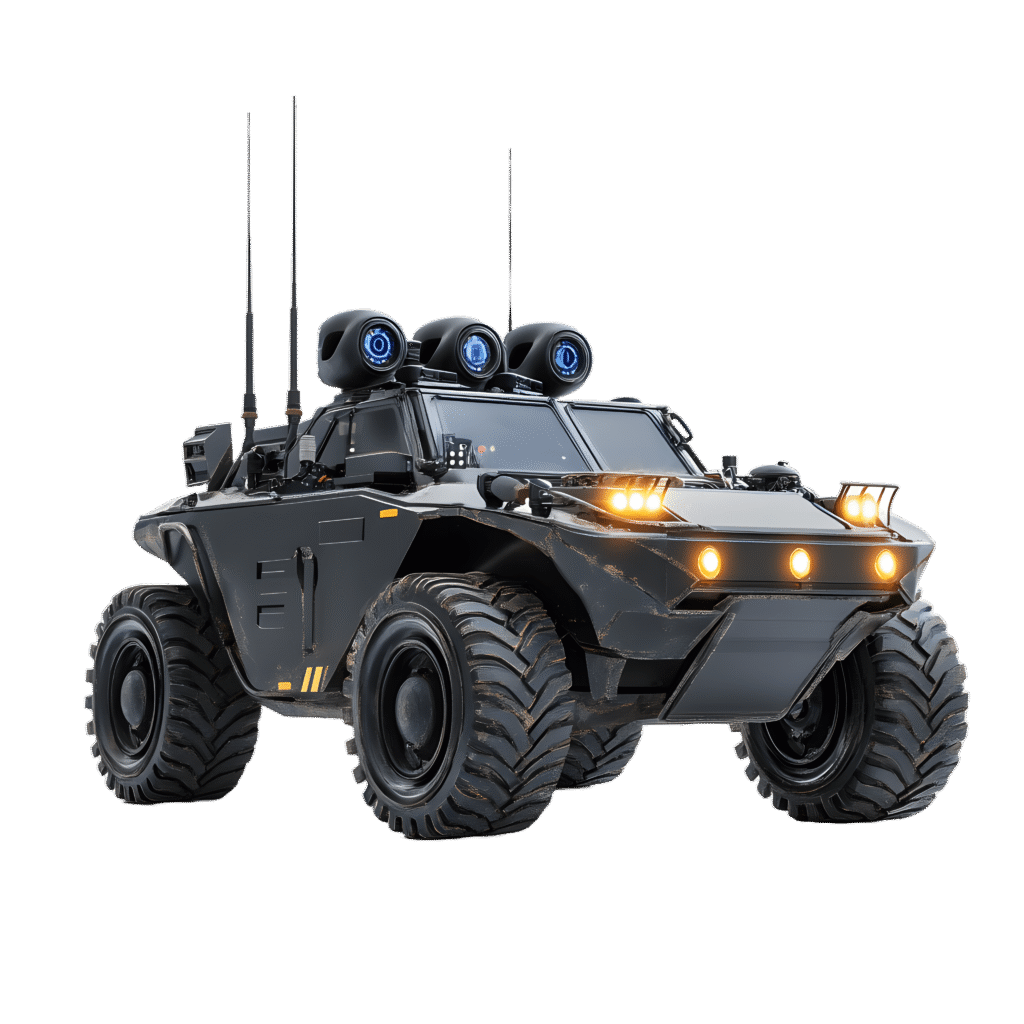
These vehicles can scout routes or exists. They can rescue stranded people or scout roads and follow the path of the fire and communicate with the command vehicle to direct the fire fighting.
Carry-All Helicopters
A Carry All, is a helicopter, that is capable of picking up and transporting a fully laden MWT from its base to the point of fire.
Helicopter Water Tanker Firefighter - HWTF
The HWTF is a purpose-built helicopter that has the carrying capacity of 50 tonnes. It will function in a similar way to an MWT, but from the air. The failure of current aircraft water bombers is that they generally drop their entire water load in one go and it is difficult to accurately target where to drop. The HWTF, with its hovering ability and its multi-function water cannons, will be able to target fires and apply the necessary amount of water in which ever form is required to extinguish the fire. From targeted water cannon fire to fast or slow shower effect, the 50 tonnes of water will be put to good use making controlling fire more effective. The underside of the helicopters will be coated in a heat-resistant material.
Helicopter Development
Boeing build the Chinnock Helicopter, so we could do a deal with Boeing to open a development factory in Australia, under licence, so that we can bring in their expertise. The carryall will be able to pick up a 55 tonne MWT, so in theory a HWT could be built to attach a 50 tonnes water tank, which when empty could be unhitched and a new one put in place, for quick turnaround.
Personal Water Cannons - PWC
Personal Back Pack Water Cannon – This is a cannon that is used by firefighters on the ground. The device is designed to conserve water, by making effective use of the water that s carried. The ability to alter the nozzle to change the water flow from spray to jet, will make fighting fires more efficient, achieving greater results. With a carrying capacity of six litres in four 1.5L bottle array, the packs can be refilled quickly by swapping out the empty bottles and replacing them. The cannon pump will be powered by an electric motor with an electric battery, which too can be swapped out when discharged.
Command Vehicle
Each unit will have a Command Vehicle, which is designed to co-ordinate the unit and its fire-fighting capabilities.
Support Vehicles - Personnel Transporter
Space Agency
Australia must start taking space seriously, whether it be communication satellites or orbital landers or exploratory satellites. Space and the planets are the future, so we must look at ways that we can contribute to this new frontier industry.
Drones
A country our size, with so many remote places, drones are an ideal way to investigate and explore the outback. Drones can be used for sporting, military or civil purposes. They are relatively cheap to make and carry less risk than a conventional aeroplane.
Renewable Energy Design and Development
We must design, develop and manufacture our own, solar panels, roof wind turbines, sea pump renewables, solar hot water systems, storage batteries, canal and pipe water turbines and airship and barrage balloon renewal generators.
Airships
Lorem ipsum dolor sit amet, consectetur adipiscing elit. Ut elit tellus, luctus nec ullamcorper mattis, pulvinar dapibus leo.