
On the 7th October 2023, violence erupted in Israel, with Hamas launching an attack on Israel killing approx. 1300 people and taking 150 hostages. The pro-Israeli countries have come out and condemned the attack as terrorism and the pro-Palestine countries have come out supporting the Palestinians, for the aggression that Israel has inflicted upon the Palestinians, for the past 80 years. Furthermore, the two sets of supporters are attacking each other over this matter and each side is attacking people for sitting on the fence and not condemning or supporting a particular side. All this proves, is, that with this mindset, there is no real intention to find a resolution for this long-standing dispute.
Because of the inherent nature of the Jews and the Palestinians, the view held, is, if you are not with us, then you are against us. As such, it is virtually impossible to bring the two sides together, because if you have previously shown support for one side, then the other side will simply not trust you. Also, it is clear, that there is no real interest from the wider world to resolve this problem. If long lasting peace is to be achieved in this region, then it is vital, that the Palestinians are found a home land or country of their own, with internationally recognised borders and a self-determining Government.
To achieve anything, it is important that each side is brought into the conversation to resolve the problem and each help to create a country called Palestine. To this end, we propose a five-year project, which will see the creation of a committee, that works out all the issues, with a view to ultimately creating a new country within five years. This set timeframe is important to demonstrate to each side, that this is a serious issue, that must be resolved.
The history of Palestine and the creation of Israel, is a case of solving one problem by creating another and then ignoring it. Unless the Jews are wiped out, it is almost certain, that the Jews will not give up any Palestinian territory, that they currently occupy, so, if this demand is persisted with, then nothing will ever be resolved.
The solution, if possible, is, to find land that can be converted into a new country. This will mean acquiring land from neighbouring countries, namely Egypt and Saudi Arabia, but the new Palestine must have a connection with the old Palestine, hence the need for Gaza to remain under Palestinian control and form part of the new country’s borders. The West Bank, will need to be traded off to Israel, in return for assisting with the building of a new Palestine.
It is proposed, that a strip of land 40 km wide running 248 km from Gaza, down the length of the Sinai, parallel with the border of Israel, is designated Palestinian land. Then a block of land in northern Saudi Arabia approximately 100 km squared, running east along the Jordan southern border from the sea to Halat Ammar and running south to Magna. The two land masses will be connected by tunnels and bridges at the Israel Jordan border in the south.
There will be incentives required to get Egypt and Saudi Arabia to sell their land. Also, all Egyptian and Saudi nationals living within these areas will need to be fully consulted with and allowed a referendum to decide if they want to become part of a new Palestine.
Egypt may welcome a buffer zone between Egypt and Israel, but as an added incentive, a new Suez Canal will be created, running the length of the new border between Egypt and Palestine. This could be paid for by the Saudi’s and built by the Palestinians. Once complete the revenue raised from shipping would be split three ways equally between Egypt, Palestine and Saudi Arabia. The long-term revenue raised by the canal, will help pay for the establishment of the new Palestinian cities and towns.
The land area of the new Palestine will comprise of approx. 10,000 Km2 for the Gaza strip and corridor and approx. 10,000 km2 in the Saudi block, making a total land mass of approx. 20,000 km2, which is similar, to the land size of Israel at 22,145 km2. Including the section of the Gulf of Aqaba, the total country area is approx. 26399. The West Bank territory is approx. 5640 km2, which when added to Israel, will increase it to 27,785.
The West Bank will remain as it is for fifty years, where after the territory will be formally internationally acknowledged as part of Israel. The West Bank being given to Israel, is their reward for supporting this project and providing New Palestine technical support on desalination systems and desert farming techniques. The reason for it not occurring for fifty years, is to give New Palestine time to establish itself and have enough homes built to accommodate the Palestinians relocating from the West Bank. It will also allow those Palestinians, for whatever reason, who do not wish to leave the West Bank, to see out their lives in their place of birth. After the hand over any Palestinians remaining in the west Bank will have to acknowledge that they will become Israeli citizens, with dual nationality. In the intervening period Israel will be allowed to lawfully settle the West Bank, as the Palestinians vacate.
When a new Palestinian Capital is created, it will be necessary to, but very carefully, relocate the Al-Aqsa and Dome of The Rock Mosques currently situated on the Temple Mount to the new capital, thus freeing up the area to enable a new Jewish Temple to be constructed. This will be easier said than done, for a number or reasons, but it will be essential in order to protect and preserve them for future generations.


The Mosques are of significant religious, cultural and historic importance to Muslims and Islam. For those not of the Islamic faith, the following is a brief outline as to why they are so significant. They represent an import part of Islamic history, where the Prophet Muhammad, journeyed in one night from Mecca to Jerusalem, where he ascended to heaven to meet God. The Dome of the Rock was built to commemorate this event.
The Mosques are situated where the Jews believe that their Temple should be and as the Jews wish to rebuild their Temple, this cannot be done whilst the Mosques exist. Hence, the concerns held by Palestinians and Muslims generally, that the Israels might destroy the Mosques if the opportunity arose. Whether this would happen or not, is open for debate. They have not been destroyed since Israel was created in 1947, so, would the Israelis really do it, maybe not, but it will only take one idiot to take matters into his own hands. To alleviate this problem, if the Mosques can be moved, then they can never be destroyed.
If the Mosques are moved and a new Temple built, then it is important, that the new Temple must have a small anti-chamber or annex, set aside which is forever Islam. The room must contain a model of the Temple Mount, with the Mosques, just as they are now. This will enable future generations of Muslims to visit the site for its historical and religious significance, something which enables Muslims to connect with their past. This is not an unreasonable request; and in the spirit of compromise and a future built on peace, there should be no reason why the Israelis could not accommodate this.
How much land is enough for the purposes of Palestine, when it comes to Egypt. How much land will Egypt agree to sell and why would they want to sell any land. If Egypt was asked to sell just a one-kilometre width strip of land, they might agree, because it is only a small amount, hardly noticeable on a map; and would become a permanent barrier between Egypt and Israel. Unfortunately, one kilometre is not enough for Palestine’s purpose. So, what would be enough, 100km, 50km or what. It is fair to say that 100km is a significant amount of land and it is extremely unlikely that Egypt would agree to such an amount. So, what is the minimum amount that Palestine would need. 50km would be ideal, whereas 30km is probably just not enough. So, a happy compromise would be 40km. Although 30km or 20km might be more preferable for Egypt, the 40km amount is probably at the maximum range of acceptability, for the Egyptians. Bearing in mind that the new Bassem Canal, which will be 500m wide, will be built within this 40km strip.
Now that the land size amount is agreed, what will be the price for this 9920 km2 strip of land. The deal must be more than just a sale of land. The benefits to Egypt must be significant in order for them to release sovereignty over this land. The price must include incentives such as, paying off Egypt’s national debt, which would significantly improve their economy, Egypt would not have to contribute any funds towards the building of the canal and they must be guaranteed 30% of the annual profits earned from the canal.
This should peak Egypt’s interest and be enough to entice them to agree. Furthermore, there is always the possibility that another country will build a canal and then Egypt will not get anything. Supporting this plan is the best outcome for Egypt. Not forgetting the tourism that will be generated by have cruise ships plying their trade up and down the new canal. It will also help the population redistribution issue as Egypt could be many new towns constructed along the length of the canal.
PROS
CONS
It is similar to that of Egypt, in so far as, that it involves the handing over of sovereign land. In Saudi Arabia’s case it is a 100km x 100km square block. It is hoped that Saudi Arabia will not sell the land, but give it away. Furthermore, Saudi Arabia will fund the entire Bassem Canal project. On the face of it, it seems a very bad deal for Saudi Arabia. They are expected to give their land away for free, then have the honour of paying for the canal, this would also include the purchase price of the 9920km Egyptian strip. Whether the land price is one separate transaction or included in the paying off the Egyptian national debt, remains to be seen, but the question begs, what’s in it for Saudi Arabia.
Saudi Arabia is an oil-based economy country, but there will come a time when their oil runs out and the oil revenue ends. To this end, Saudi Arabia is building many projects to create an alternative economy, such as the line and other projects in Neom. The problem facing them, is, that these projects require a certain type of wealthy person to come and reside in them; and there is simply not enough of them; and many other middle eastern countries are do the exact same thing.
Saudi Arabia will, by investing in this project, become a 30% owner of the Canal and its annual profits. The profits from the canal will long continue after their oil runs out. As the canal will be 500m wide, it is designed to cater not just for cargo ships, but be wide enough to allow for passenger ships as well. Many of Saudi’s building projects are situated near where new Palestine will be placed. This means that the allure of the new projects will be within easy reach of new Palestine and can be a destination point for cruise ships, with passengers wanting to experience the imaginative building projects such as the line. Tourism to the region could become another money earner, justifying the cost of these projects.
As Palestine will get the other 30% ownership of the canal, this will leave 10% for other investors, who may wish to contribute to the project.
Is this just wishful thinking or does it have any chance. The answer is, that this can work if all parties agree. And although unusual and possibly difficult to implement, if they want to do, it can be done. Through international cooperation the Palestinian issue will be finally resolved.
PROS
CONS

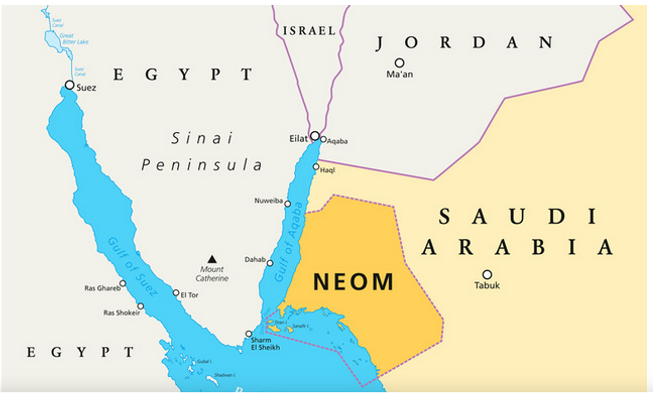
The Neom area is part of the Saudi Arabian plan to invigorate the region. The proposed land of New Palestine covers much of the northern area of Neom.
The Bassem Canal name originated from Dr Bassem Raafat Mohamed Youssef. He has been a prominent spokesman advocating peace in Palestine, he has been critical of the ambivalence shown by the West to the suffering in Gazza and the significant loss of life. He is an Egyptian with a Palestinian wife, which symbolises the proposed union between Egypt and the New Palestine via the Bassem Canal. The name Bassem means Smiling, Cheerful, Beaming or Bringing Joy, the very thing we hope to achieve by creating a New Palestine and the Bassem Canal. The name is often chosen for its positive, joyful connotation and pleasant demeanour; something everyone should wish for in hoping that a positive attitude will prevail and bring the suffering to an end.
The proposed Bassem Canal will be situated between Egypt and New Palestine. It will run from Arish in the north to Nuweibaa in the south. It will be 248 km long, 500 metres wide and 30 metres deep. It will be designed to accommodate the largest oil tankers and the largest passenger liners. The largest oil tanker has a width (beam) of 68.6m, with a depth of 20m. The largest passenger liner is 48.5 metres wide.
The canal will have the following dimensions
75m | 50m | 100m | 50m | 100m | 50m | 75m |
There will be two main shipping lanes each 100m wide with a 50m dividing lane. There will be two 50m outer dividing lanes leaving two 75m cruise lanes. The two main lanes will be designated north and south only. The outer lanes will hopefully be able to cater for many vessels travelling both north and south.
The two main lanes will be for commercial marine vessels, such as oil tankers and cargo ships. The two 75m lanes will be for passenger ships and other vessels to use. It is hoped that towns and small cities will develop along the length of the canal, serving both tourist ships and fishing fleets.
Will the Palestinian people agree to this plan, bearing in mind that they are being asked to leave their country and end their claim to the land that is now Israel. As the Palestinians are being confirmed to an ever-decreasing area, to some degree they have already lost their land for good. This is why it is important that they hold onto the Gaza strip to remind them of what was once theirs and to allow them a connection to the old country. There are approximately 15.2 million Palestinians worldwide with only 7.5 million residing in historic Palestine. So, for the majority, they have already left their country, so relocating to the New Palestine, should not be an issue.
A New Palestine will afford future generations of Palestinians the chance for a better life, one without war; and to be able to lead normal lives. This may not be the most perfect solution, but it is one that is achievable and it gives the Palestinians a fresh start and a blank canvass upon which to stamp their future aspirations. It is important that any decision taken, is ratified by a public referendum.
This proposal will bring to an end the Jewish homeland question. The Jews will finally have an undisputed homeland where they can live in peace and finally rebuild their Temple. So, will they support it.
