
The Privatisation of utilities, without competition, is nationalisation by another form. The principles of Conservativism are founded upon freedom and entrepreneurism, but where a company holds a monopoly and cannot be challenged then it too will be beset by the very same problems as that of a nationalised company being run by the government. It will only be a matter of time before the rot sets in, bad habits take hold and inefficiency and greed dominate.
Whether Conservatives like it or not, history shows that privatised utilities are no more efficient than nationalised utilities. The lack of competition enables the board to raise prices, lower standards and fail to hold sufficient reserves for contingencies. The only solution is to nationalise a utility, but run it as though it were privatised. This way you will get the efficiency and productivity, but without profit taking and price hiking.
Traditionally Labour and Socialists are the ones that nationalise industry, however their lack of business acumen and entrepreneurism results in the industry been poorly run and dominated by unions and their unrealistic demands. Whereas Conservatives privatise nationalised industries in the hope that the new private owners will run the industry efficiently and productively, resulting in a successful and profitable business. In the case of utilities, we encounter a problem. Labour and socialists cannot run them properly and private ownership finally deteriorates into making greater profits at the expense of the people. Ironically, nationalised industries can work, but only under a Conservative Government. This was proven by Margaret Thatcher with British Airways. Lord King was appointed chairman of the then state-owned loss-making British Airways. Under Lord Kings stewardship, he managed to turn this once ailing industry into an efficient profit-making business. The airline was then sold into private ownership. Despite everything that was said, it was proven that a nationalised airline could operate efficiently, productively and profitably under state ownership.
Conservatives that balk at the idea of having any nationalised industries, must remember that the Armed Services, Police, National Health and Government are all State run. Would Conservatives, even the far-right Libertarians’, really want a privatised army, navy or air force. Hostile Corporate take overs might take on a whole new meaning.
With this in mind the concept of having state run utilities is not as daunting as it may seem, especially if the end result is to improve the livelihoods of the people. Pure Conservativism may not entertain the notion of nationalised utilities, but National Conservatism can and does entertain this concept. Failure to learn from past mistakes, will condemn the future to the same mistakes. The failure of private run utilities, is not unique to Australia. All countries that have privatised their utilities, without appropriate regulation, have seen services and standards fall, whilst prices have risen exponentially. The most appropriate word to describe the running of utilities, today, is GREED.
Australia should have the cheapest and most reliable electricity in the world. We have world-scale and world-class coal, gas and uranium reserves. Yet our electricity sector no longer reflects that. We are open to any form of electricity generation, and will provide legislative certainty for the ongoing use of fossil fuels. Subject to environmental concerns, we will remove the barriers to building more dams for hydro-power and plan for nuclear power as well as a nuclear fuel cycle industry
To achieve this, we propose the following.
Coal is the current and future source of all our base load electricity. Coal is the cheapest way of producing cheap and reliable electricity. In Victoria we plan to design, build and operate at least three 2GW lean burn coal fired power stations. The estimated cost will be $3billion each making a total of $9billion. They take approximately three years to build. Power output units 200MW powers 38,000 homes. 1 GW powers 750,000 homes.
The three new power stations producing a total of 6 GW of electricity will be able to power 4.5 million properties in Victoria. With approximately 3 million homes in Victoria, we will have enough electricity for our needs for the foreseeable future.
Australia should also have the cheapest and most reliable gas supply in the world. We will support landholders’ rights to allow gas production on their properties, and to a reasonable return for that access and extraction, to help ensure there is sufficient quantity available for our domestic and export markets.
In conjunction with the private gas industry, we will open-up Victoria’s gas field reserves. We will partnership with the Gas industry so that we can achieve two objectives. First, to provide cheap reliable gas supplies to homes and industry, with a view to halving the cost of gas to Victoria consumers. Second, we want to sell gas on the open market at current high market rates so that the revenue raised we can use to repay the State debt of $152B.
The current nuclear debate is more about avoiding having to talk about coal, rather than a serious discussion about our energy needs. The way some people talk about nuclear power, is if it is easy to do. Unfortunately, creating electricity from nuclear power is not easy or quick, there will be a number of procedures to overcome long before we see any electricity generated.
The first issue to address is the removal of the moratorium on nuclear power in Australia. This will need to be passed by a bill introduced to parliament. It is here where the first line of resistance will be met. Those opposing nuclear, will attempt to block the bill, first in the lower house and then the upper house. They will attempt to delay the bill in the Senate for as long as they can. It could take at least a year if not longer for the Bill to pass. This is presupposing that there are no legal challenges brought by anti-nuclear parties. If they do then the matter could be held up in the civil Courts for years.
Having achieved the removal of the moratorium, we will only be at the start of the project. We then have to plan the how, where and when. Determine what size will it be and how many units are required and the costs involved. We will need to acquire the necessary knowledge and skills to design and build a nuclear power plant. We will need to train people in how to assemble the nuclear reactor, as well as produce the material to manufacture the uranium rods. We will need to establish what additional infrastructure is require to transmit the electricity. We will have to consider long term maintenance costs and issues and finally how we will deal with the spent uranium and where to store it.
There will be studies and surveys undertaken to canvass opinions on where to situate the power plant(s). With the biggest problem coming from residents, who although may support nuclear power, would prefer not to have a plant situated near them. Once a suitable place is found, then you have to build the plant and that will take at least three years depending upon the size of plant.
The UK’s Sizewell C Nuclear Station is a 3.2 gigawatt plant, which will produce electricity for 6 million homes. It is expected to cost from $20m to $30m pounds with the construction time estimated to be between nine and twelve years.
If we use the UK’s as an example and if we take a realistic approach to the matter, then it would be highly unlikely that we would have a fully functional nuclear power plant within ten years. You would have to estimate between 20 and 30 years.
A possible cheaper and quicker method might be to build Thorium Reactors. Thorium is a self- enriched nuclear element, that is safe to use and requires less processes to make the electricity. It is safe, for if there is a melt-down, thorium simply goes back to is natural state. India is currently the leader in thorium reactors, so, we could learn from them.
Nuclear power may be a viable long-term possibility, but it won’t solve our electricity problems in the short term.
We support renewal energy for the original concept of it being free, not the cheapest. We want to see Australian designed and manufactured solar panels on the roofs of all buildings. We want to develop battery storage capacity so that every home can save and conserve excess electricity for evening use.
Targets and Net Zero
We will scrap all taxpayer and cross-subsidies for electricity generation and allow market forces to determine the best outcomes for Australian consumers and business.
Key Points:
We will scrap all Net Zero Carbon Targets or Agendas
We will withdraw from the Paris Climate Accord
We will withdraw from the UN Climate Accord
We will not be bound by any foreign objective or target
Australia produces less than 1.5% of global CO2 emissions. Even if our emissions were reduced to zero, it would make no perceptible difference to the climate.
Ideological obsessions with uneconomic renewable technologies to meet unrealistic emissions targets to prevent ‘climate change’ have made our energy unreliable and expensive. Targets and subsidies for renewable energy distort the market and disadvantage consumers. We support renewable energy as an option for electricity generation but we oppose taxpayer and cross-subsidies to support it.
We will scrap all taxpayer and cross-subsidies for electricity generation and allow market forces to determine the best outcomes for Australian consumers and business.
The problem with renewables, is, that the devices that produce the power are situated a static position, so when the wind stops blowing and the sun gets obstructed by clouds the power output drops. Wind turbines are inefficient at sea level and should be high in the sky where the winds are much stronger. Also, once you are above the clouds you are exposed to maximum sunshine, making solar panels far more efficient. So, how do you get wind turbines and solar panels high in the sky. The answer is to affix them to an airship, which can hover above the clouds and move to where the maximum out-put is achieved. Wind turbines that are above the clouds can be much smaller in size as they are able to spin much faster and produce more electricity. Airships of a certain size and shape will be able to have the upper surface covered in solar panels and the under fuselage can have multiple wind turbines suspended to harness the high-speed winds. Stored within the fuselage of the airshow will be storage batteries to collect and store the electricity produced. The airship will have a winch cable that can be lowered to an electrical connection point, where the electricity generated can be fed into the grid or the batteries can be discharged into the grid. The airships being mobile can be flown anywhere, so if a town is without power, then the airship can sit above the town generating temporary electricity.


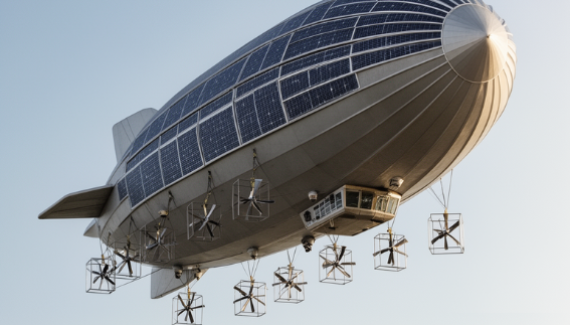


We can also use barrage balloons that are fixed to an anchor point and winched to the appropriate height. They can have a few wind turbines affixed to the underneath and solar panels on the upper surface. They will not need batteries as the fixing cable can transmit the generated electricity into the grid. This concept will cause less environmental damage and be more efficient.
We need to research and produce new types of fuel. From sugar we can produce ethanol, from seeds and plants we can produce other bio-fuels, all of which can reduce our dependency on crude oil and petrol. Oil can be synthesised from coal and in view of our huge reserves of coal, this should be a priority.
The resource sector is very important to Australia, the majority of which is controlled by private companies. To locate, setup and extract the resources costs a lot of money, hence the profits that the mining companies make. In other words, the return on investment has to be profitable. Thanks to these private companies the government is able to accrue tax and royalties without spending anything. We will continue this government private industry arrangement to ensure that these companies remain profitable and the government gets its share. We will also look at expanding the resource sector, but everything must be pro-Australian, we want less overseas investors and more Australian investors, including the government.
Oil is a very important resource that is vital for our country. Australia does have its own oil, which we will need to explore and drill for, to supplement our imports. For a country that is so abundant in coal and gas, it is surprising that we do not have more oil, or perhaps it is still waiting to be discovered. We should build oil storage depots, so that when oil is being sold on the cheap, we can buy large quantities and hold it in storage for future use.
